
What it is
The operating system for working with JMG.
Projects, agreements, invoices, support tickets, and resources in one place. Clients don't buy it — they get it. It's how the relationship runs.
— to clipboardThe JMG Hub
Every capability we'd build for you is already running in production for us — payments, credentials, tenant isolation, client document workflows. We live with the consequences before you ever do.
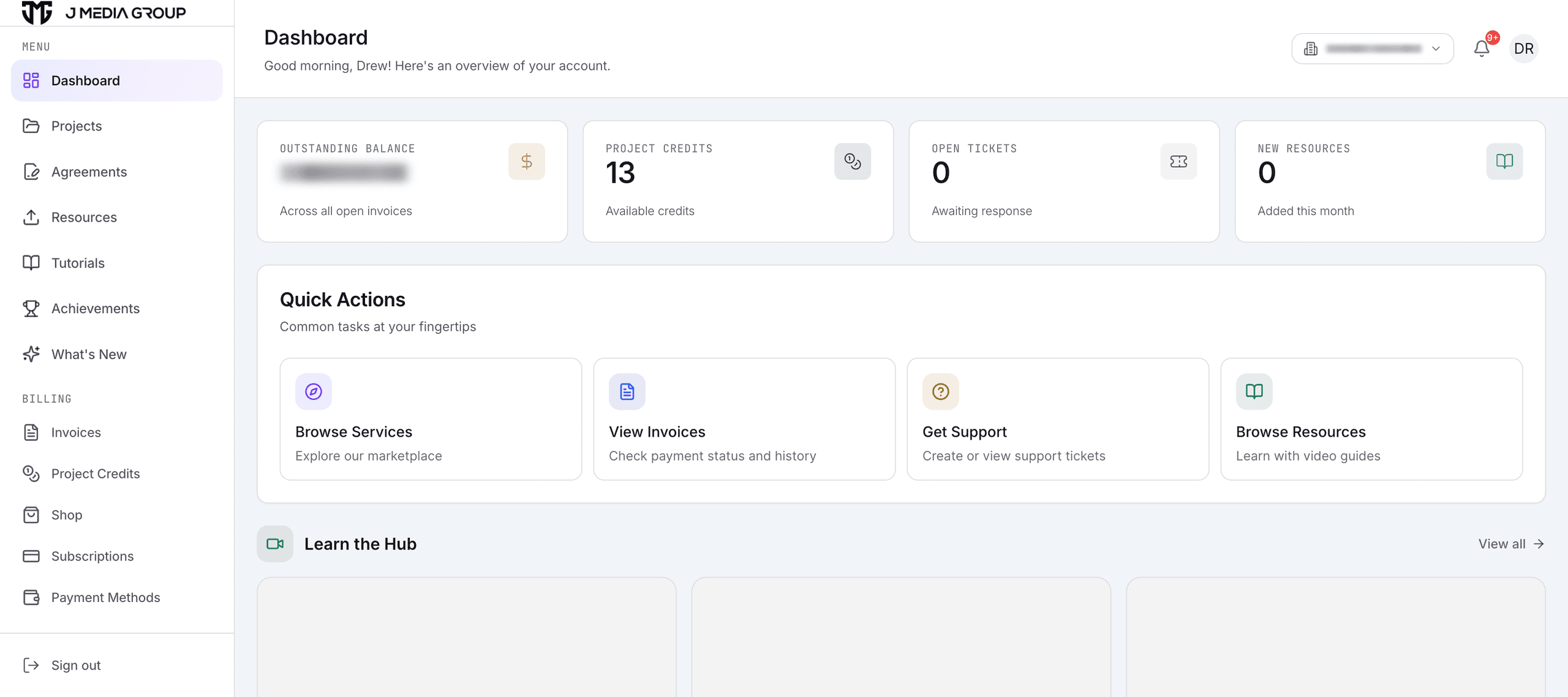
The client dashboard. Projects, agreements, invoices, support, and resources — the surface our clients actually work on, not a demo environment.
Running in productionWhat it is
The Hub isn't something we sell. It's where our clients sign in and do real work — and it's the most honest answer we can give to “can you actually build that?”
What it is
Projects, agreements, invoices, support tickets, and resources in one place. Clients don't buy it — they get it. It's how the relationship runs.
What it isn't
Nothing on this page is mocked up or staged for the pitch. It's the system we run our own business on, with our own money moving through it.
What it proves
Four things worth pointing at. Each one is a problem we had to solve for ourselves before we could offer to solve it for anyone else.
01 · Money
What we built
Stripe invoicing, subscriptions, refunds, disputes, and ACH — with idempotent webhooks, so a retried event never charges twice. A fractional credits ledger with hierarchical pooling. An estimator resolving quotes from a versioned pricing schema.
What it means for you
Any usage-based or prepaid billing model, and configure-price-quote tooling for a complex product line — built by people who have already handled a dispute at 2am.
02 · Trust
What we built
An AES-256 credential vault with PIN gating and access audit logging. Row-level security, privilege-escalation triggers, and rate limiting throughout.
What it means for you
Systems that handle credentials and sensitive data, and multi-tenant applications where one client seeing another's data isn't a bug we're hoping to avoid — it's structurally prevented. These are controls we implement, not certifications we hold.
03 · Front end
What we built
Tokenized public proposal pages with signature capture, so a client can sign without an account. Built for mobile, with dark mode throughout.
What it means for you
Secure, login-free client document workflows — and an interface your users won't route around, which is the difference between a tool that gets adopted and one that gets abandoned.
04 · Longevity
What we built
A schema history migrated forward, repeatedly, without breaking what was already live and carrying real money.
What it means for you
The discipline to maintain a system over time — a different skill from shipping one, and the one that decides whether your platform is still an asset in three years.
Stated as fact
Pick any one of those three and try to buy it as an add-on. We author the system; we don't rent it, and we don't configure our way to something that only looks finished.
Inside the relationship
Once you're a client, this is the front door. Not an email thread, not a shared folder that nobody can find — one place where the project, the paperwork, and the money all live.
Ongoing work runs on project credits: a self-service subscription with organisation-level pooling, built to run our own client relationships before it ran anyone else's.
What's in there
Ready to get started?
Tell us what your business actually runs on — or should. We'll reply within one business day with a senior point of contact.
Already know what you need? Start a project